
How Credential Stuffing Attacks Actually Work
Your password isn't being guessed by a hooded hacker in a dark room; it is being recycled by an industrial-grade botnet. If you use the same login credentials for a minor retail site as you do for your primary bank account, you have already done 90% of the work for a cybercriminal. Credential stuffing is the automated exploitation of human predictability, turning a single data breach at one company into a skeleton key for a user's entire digital life.
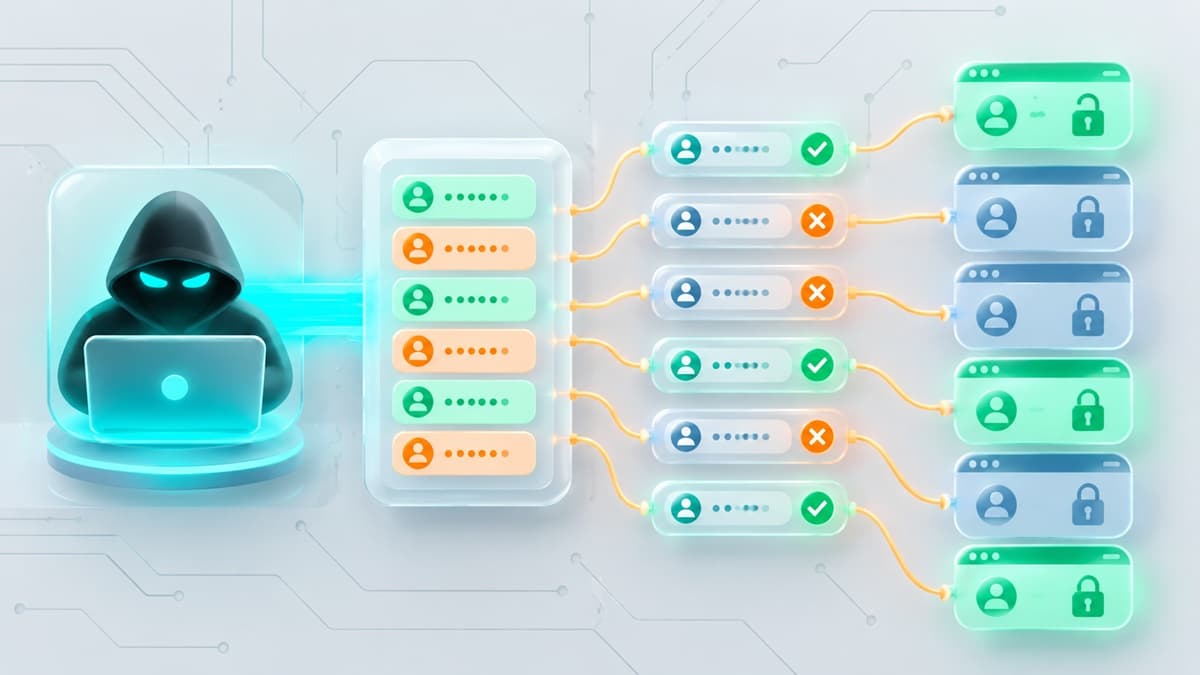
Credential stuffing is a cyberattack where attackers use automated scripts to test millions of stolen username and password pairs against various web services. Unlike brute-force attacks, which attempt to guess a password through trial and error on a single account, credential stuffing relies on "combo lists"—verified sets of credentials leaked from previous breaches. The attacker assumes that a significant percentage of users reuse passwords across multiple platforms, and statistically, they are always right.
The scale of these attacks is staggering. According to industry reports from major Content Delivery Networks (CDNs), credential stuffing attempts account for billions of login requests every year, often making up more than 50% of a site's total login traffic during a concentrated campaign. Because the attacker provides a "correct" password, these attempts frequently bypass basic security filters that only look for "incorrect" login patterns.
The Industrial Mechanics of a Stuffing Campaign
Credential stuffing is not a manual effort. It is a highly optimized supply chain consisting of four distinct phases. To defend against it, you must understand the velocity at which these stages move.
1. The Acquisition of Raw Intelligence
The process begins with the "combo list." When a company suffers a data breach, the exfiltrated database is rarely kept by a single person. It is quickly unhashed, formatted into "username:password" or "email:password" pairs, and distributed across dark web marketplaces or Telegram channels.
Massive aggregations like "RockYou2021" or the "Combination of Many Breaches" (COMB) contain billions of unique entries. These lists serve as the raw fuel for the attack. Attackers do not care where the data came from; they only care that the credentials were valid at some point in time.
2. Validation and Scrubbing
Raw lists are often "dirty," containing duplicates, invalid email formats, or credentials for defunct services. Before launching a high-stakes attack against a financial institution, attackers use "checkers" or "account crackers." These are lightweight scripts designed to test the list against low-security targets to see which accounts are still active.
This stage filters the billions of raw entries into a "refined" list of active users. If you suspect your data has been included in one of these historical dumps, you should immediately use a password breach checker to identify which specific accounts require an emergency password reset.
3. The Automated Stuffing Phase
This is the core of the attack. The refined combo list is loaded into specialized software like OpenBullet, SilverBullet, or Sentry MBA. These tools are configured with "configs"—scripts specifically tailored to bypass the login page of a target website.
The bot performs the following actions at a rate of thousands of attempts per minute:
- Request Emulation: The bot mimics the specific HTTP requests sent by a legitimate browser or mobile app.
- Fingerprint Randomization: To avoid detection, the bot varies its User-Agent strings, screen resolutions, and header configurations.
- Bypassing Simple Rate Limits: By distributing the load across a massive infrastructure, the bot ensures that no single account or IP address triggers a "too many failed attempts" lockout.
4. Monetization and Account Takeover (ATO)
When the software identifies a successful login, it is flagged as a "Hit." These hits are the final product. The attacker then moves to the monetization phase, which varies depending on the target:
- Financial Drain: Transferring funds or purchasing gift cards.
- Data Scraping: Extracting personal identifiable information (PII) for identity theft.
- Resale: Selling "verified" premium accounts (streaming, gaming, or food delivery) on secondary markets for a fraction of their retail value.
- Privilege Escalation: Using access to a corporate email to launch internal phishing attacks.
Credential Stuffing vs. Brute Force: The Critical Distinction
While both attacks target login forms, their methodologies and the defenses required to stop them are fundamentally different.
Brute Force Attacks
In a brute force attack, the attacker targets one specific account and tries to guess the password. They might use a dictionary of common passwords or try every possible character combination.
- The Signal: Thousands of failed attempts on a single username.
- The Defense: Account lockout policies (e.g., locking the account for 30 minutes after 5 failed tries).
Credential Stuffing Attacks
In a credential stuffing attack, the attacker targets millions of accounts and tries only one or two passwords for each.
- The Signal: One failed attempt across a million different usernames.
- The Defense: This is much harder to detect because it does not trigger traditional account lockouts. To the server, it looks like a massive wave of users simply forgot their passwords simultaneously. This necessitates advanced behavioral analysis and device fingerprinting.
The Infrastructure: Proxies and Botnets
The primary challenge for an attacker is the IP address. If a website receives 50,000 login requests from a single IP in an hour, it will be blacklisted. To circumvent this, attackers utilize residential proxy networks.
Residential Proxy Networks
Unlike data center IPs, which are easily identified and blocked, residential proxies are IP addresses assigned to real homeowners by Internet Service Providers (ISPs). Attackers gain access to these through:
- Malware: Compromising IoT devices (smart cameras, routers) and turning them into proxy nodes.
- Proxy-as-a-Service: Buying access to "legitimate" proxy networks that rent out bandwidth from users who have installed certain "passive income" apps.
By routing each login attempt through a different residential IP, the attacker makes the traffic look like it is coming from thousands of different homes across the globe. This makes IP-based blocking almost entirely ineffective. Companies often struggle to distinguish these bots from real customers, a topic explored in depth in our analysis of why companies block disposable emails.
The Economics of the Attack
Credential stuffing persists because it is incredibly cheap to execute and highly profitable. The "Cost Per Hit" is the primary metric for attackers.
Attack Costs
- Combo Lists: Often free or available for a few dollars on forums.
- Bot Software: Open-source or low-cost subscriptions.
- Proxies: The most expensive component, yet still affordable when compared to the potential payout.
Potential Returns
If an attacker stuffs 1,000,000 credentials and achieves a success rate of just 0.2%, they have 2,000 compromised accounts. If those accounts are for a high-value service like a cryptocurrency exchange or a major retailer with saved credit cards, the profit can reach tens of thousands of dollars within hours. This high Return on Investment (ROI) ensures that credential stuffing remains a preferred method for cybercriminals.
Strategic Defense: How to Protect Your Identity
You cannot control whether a company you use gets breached, but you can control the "blast radius" of that breach.
1. Eliminate Password Reuse
The only way to render a combo list useless is to ensure that the password leaked from "Site A" does not work on "Site B." Use a dedicated password manager to generate and store unique, high-entropy passwords for every service. If every account has a unique key, credential stuffing fails at the first step.
2. Implement Multi-Factor Authentication (MFA)
MFA is the most effective technical deterrent against automated stuffing. Even if an attacker has your correct password, they cannot provide the second factor (TOTP code, hardware key, or push notification). While attackers are developing "MFA Fatigue" attacks—spamming users with prompts until they click "Approve"—having MFA enabled still stops 99% of automated stuffing attempts.
3. Identity Segmentation and Disposable Emails
One of the most effective ways to prevent your primary accounts from being linked to breaches is to use different email addresses for different levels of risk. You should never use your primary "banking" email to sign up for a newsletter or a one-off e-commerce site.
Understanding what is disposable email is critical here. By using a disposable email or a burner email for non-essential services, you ensure that if that service is breached, the email address in the combo list doesn't match the one used for your sensitive accounts. Best-TempMail provides an essential layer of privacy by allowing you to create these temporary buffers. Using a temp mail address for secondary signups ensures your permanent identity remains disconnected from low-security databases.
Defensive Engineering: Protecting the Server
For developers and system administrators, defending against credential stuffing requires moving beyond simple rate limiting.
Behavioral Analysis and Fingerprinting
Modern defense involves analyzing the "telemetry" of a login attempt.
- Velocity Tracking: Monitoring the rate of logins across the entire platform, not just per IP.
- Browser Fingerprinting: Identifying the specific combination of browser version, plugins, and hardware settings. If 5,000 "different" users all have the exact same hardware fingerprint, they are likely the same bot.
- Headless Browser Detection: Identifying tools like Puppeteer or Selenium that bots use to render pages.
Testing and Validation
Developers often use the Best-TempMail API to test how their registration and login flows handle automated traffic. This is particularly useful when automating OTP verification in end-to-end tests, allowing teams to simulate high-volume user creation while ensuring their security headers and bot-detection logic are functioning correctly.
Technical Mitigation Steps
- Analyze Headers: Look for missing or inconsistent headers (e.g., a User-Agent that doesn't match the TLS handshake).
- Implement CAPTCHAs: Use risk-based CAPTCHAs that only appear when the system detects suspicious behavioral patterns.
- Monitor Leaked Credentials: Use APIs that check if a user's submitted password has appeared in known breaches and force a reset if a match is found.
Conclusion
Credential stuffing is a volume-based threat that thrives on the friction of modern security. Attackers bet on the fact that most people value convenience over complexity. By using a password manager, enabling MFA, and utilizing tools like Best-TempMail to segment your online identity, you move from being an easy target to an unprofitable one.
For more strategies on securing your digital footprint, read our how to stop spam emails for good guide or consult our email privacy guide for advanced protection techniques.
Frequently Asked Questions
Is credential stuffing the same as phishing?
No. Phishing is a social engineering attack designed to trick you into revealing your credentials. Credential stuffing is an automated technical attack that uses credentials already stolen from a previous, unrelated data breach.
Can a long password prevent credential stuffing?
Length and complexity only protect you against brute force. If a 30-character password is leaked in a breach and you use that same 30-character password on five other sites, a credential stuffing bot will get into all of them instantly. Uniqueness is more important than complexity.
How do I know if my email is in a combo list?
You can use specialized breach notification services or a password breach checker. Additionally, if you receive "unauthorized login" alerts or "password reset" emails you didn't request, it is a strong indicator that your credentials are being stuffed.
Why don't websites just block all automated traffic?
It is difficult to distinguish between "good" bots (like search engine crawlers or accessibility tools) and "bad" bots. Furthermore, attackers use residential proxies to make their traffic look exactly like legitimate human users. Overly aggressive blocking can result in "false positives," where real customers are locked out of their accounts, leading to lost revenue and support costs.
Does 2FA make me immune to credential stuffing?
It makes you immune to the automated portion of the attack. However, if an attacker finds a working password for a high-value account, they may attempt manual follow-up attacks, such as SIM swapping or phishing, to obtain your 2FA code. It is a vital layer of defense, but it should be part of a broader strategy that includes unique passwords.
Your temp mail is ready right now
No signup, no password. A disposable inbox waiting the moment you open the page.
Get My Free Temp Mail →